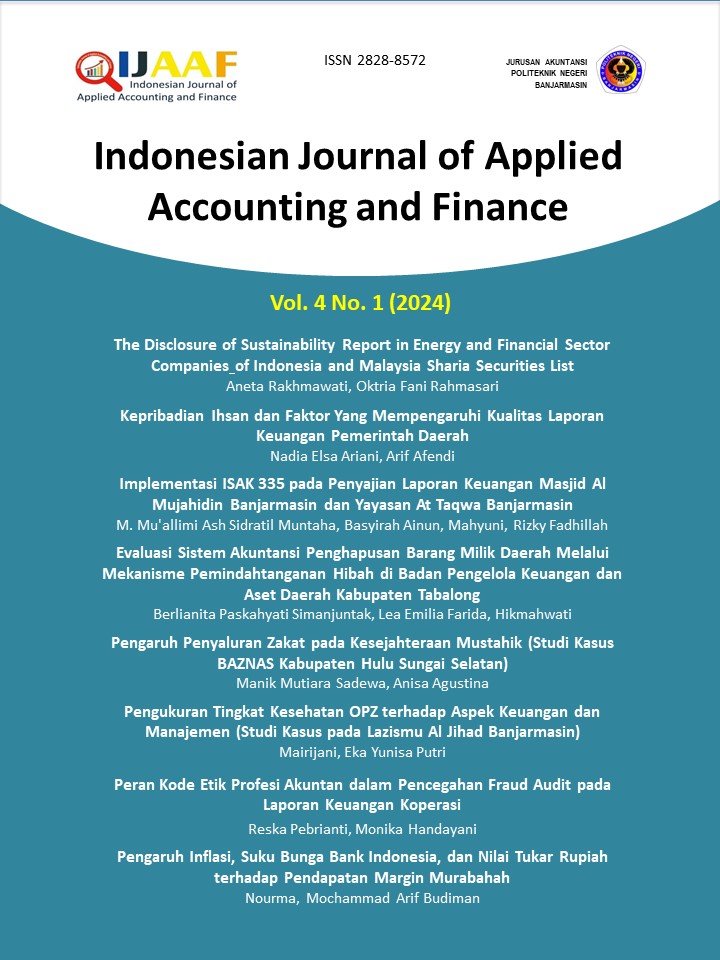
Peran Kode Etik Profesi Akuntan dalam Pencegahan Fraud Audit pada Laporan Keuangan Koperasi
DOI:
https://doi.org/10.31961/ijaaf.v4i1.14709Keywords:
Code of Ethics, Financial Reports, Fraud, Internal Supervision, TransparencyAbstract
Fraud in financial reporting is one of the biggest threats to transparency and accountability of organizations, including cooperatives. This study aims to analyze the role of the code of ethics of the accounting profession in preventing audit fraud in the financial statements of the Sejahtera Bersama Savings and Loan Cooperative (KSP-SB) in 2023. A qualitative approach based on case studies was used to evaluate the application of the principles of the code of ethics, such as integrity, objectivity, and professionalism, which are relevant in preventing fraud. The results of the study indicate that consistent application of the code of ethics can minimize the risk of fraud, strengthen transparency, and increase public trust in financial reports. However, the study also found major challenges, such as weak internal supervision and lack of understanding of the code of ethics by cooperative managers. Therefore, this study recommends strengthening supervision, comprehensive code of ethics training, and stricter regulations to prevent similar cases from recurring in the future.
Downloads
References
Andrean, I., & Salim, S. (2021). Fraud Diamond dalam Mendeteksi Financial Statement Fraud pada Perusahaan Manufaktur. Jurnal Ekonomi, 26(11), 187-207. https://doi.org/10.24912/je.v26i11.773.
Andriani, Ainun, B., & Budiman, M.A. (2023). Integrasi Kode Etik Akuntan Syariah Internasional di Indonesia, Mungkinkah? Imanensi: Jurnal Ekonomi, Manajemen, dan Akuntansi Islam, 8(2), 1-16. https://doi.org/10.34202/imanensi.8.2.2023.1-16.
CNBC Indonesia. (2023). diambil dari https://www.cnbcindonesia.com/market/20230717105835-17-454917/ini-kronologi-lengkap-kasus-ksp-sejahtera-bersama
Fauziah, N. (2016). The Effect of Internal Control and Whistle Blowing on Fraud Prevention in Banking. International Journal Management Science and Business, 4(2), 89-100. https://doi.org/10.17509/msb.v4i2.59853.
IAI. (2020). Kode Etik Akuntan Indonesia. Jakarta: Ikatan Akuntan Indonesia.
Kamayanti, A. (2016). Metodologi Penelitian Kualitatif Akuntansi: Pengantar Religiositas Keilmuan. Jakarta: Yayasan Rumah Peneleh.
Murtiningrum, R. (2023). Pengaruh Audit Internal, Pengendalian Internal, dan Wishtleblowing System terhadap Pencegahan Fraud. Jurnal Multidisiplin Indonesia, 2(7), 1561-1565. https://doi.org/10.58344/jmi.v2i7.314.
Rini, W. A. S., & Suwardi, E. (2021). Peran Kode Etik dalam Pencegahan Fraud pada Auditor di Lingkungan Badan Pemeriksa Keuangan (Studi pada BPK RI Perwakilan Jawa Timur). ABIS: Accounting and Business Information Systems Journal, 9(2). https://doi.org/10.22146/abis.v9i2.65892.
Syuhri, S., & Nurul, N. F. (2024). Implementasi Pengawasan Internal pada Koperasi (Studi pada Koperasi BMT Maslahah Jawa Timur). KHIDMAH: Jurnal Pengabdian Masyarakat, 4(2), 1-8. https://doi.org/10.55210/khidmah.v4i2.451.
Wardoyo, D. U., Arya, M., Pawestri, D. W., & Shakuntala, B. (2022). Whistleblowing System dan Surprise Audit: Strategi Pencegahan Fraud. EKOMA: Jurnal Ekonomi, Manajemen, Akuntansi, 1(2), 157-168.
Wolfe, D. T., & Hermanson, D. R. (2004). The Fraud Diamond: Considering the Four Elements of Fraud. The CPA Journal, 74(12), 38-42. https://digitalcommons.kennesaw.edu/cgi/viewcontent.cgi?article=2546&context=facpubs.
Downloads
Published
How to Cite
Issue
Section
License
Copyright (c) 2024 Reska Pebrianti, Monika Handayani

This work is licensed under a Creative Commons Attribution 4.0 International License.