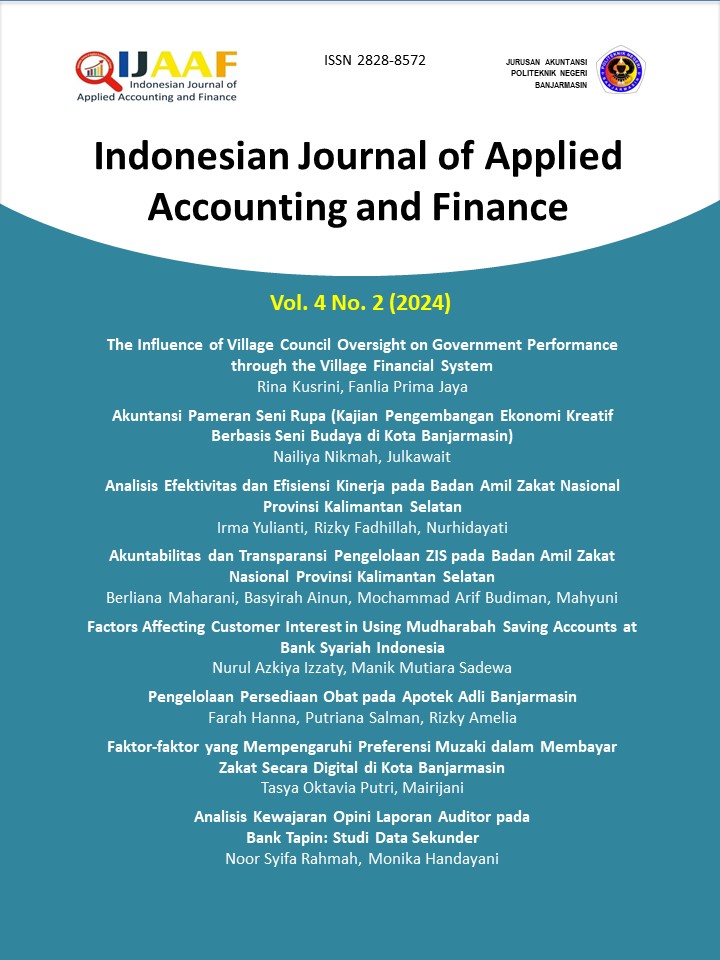
Analisis Efektivitas dan Efisiensi Kinerja pada Badan Amil Zakat Nasional Provinsi Kalimantan Selatan
DOI:
https://doi.org/10.31961/ijaaf.v4i2.2560Keywords:
BAZNAS, Effectiveness, Efficiency, Zakat Management OrganizationAbstract
As an institution responsible for the management of zakat, BAZNAS must meet the criteria of strong, credible, efficient and effective. Efficiency and effectiveness are two indicators that can be used as benchmarks for a good management system in an institution. The results of measuring effectiveness and efficiency are expected to be able to improve the quality of zakat institutions, especially in terms of collection and distribution carried out by BAZNAS South Kalimantan Province. The method used is a quantitative descriptive method with primary and secondary data. The sample in this study is the financial report of BAZNAS South Kalimantan Province in 2019-2023. The research questions are about the level of effectiveness and efficiency of performance at BAZNAS South Kalimantan Province. The results showed that in the last 5 years the average effectiveness performance has been in the very effective category, there are only a few that show effective performance including Gross Allocation to Collections Ratio in 2020 and Gross Allocation to Collection Ratio Non-Mil in 2019 and on efficiency performance is in the inefficient category, only the collection ratio is in the effective category.
Downloads
References
Budiman, M.A. (2009). Pola Distribusi Dana Zakat pada Badan Amil Zakat di Provinsi Kalimantan Selatan. Intekna, 9(1), 84-89.
Drucker, P. (2012). The practice of management. Routledge.
Handayani, L., Putri, K.W., & Fahmi, M.Y. (2019). Factors Affecting Community Trust to Pay Zakat at the National Board of Zakat (BAZNAS) of South Kalimantan Province. Indonesian Conference of Zakat-Proceedings, 179-191.
Hayatika, A. H., & Suharto, S. (2021). Manajemen Pengumpulan, Pendistribusian, dan Penggunaan Dana Zakat oleh Badan Amil Zakat Nasional sebagai Upaya Peningkatan Pemberdayaan Ekonomi Umat. Jesya (Jurnal Ekonomi dan Ekonomi Syariah), 4(2), 874–885.
Hood, C. (1995). The “new public management” in the 1980s: Variations on a theme. Accounting, Organizations and Society, 20(2–3), 93–109.
Marliyah, M., & Sari, P. A. (2022). Analysis of the Effectiveness of Distribution of Zakat Funds at Baznas of North Sumatra Province. Jurnal Ekonomi, Manajemen, Akuntansi dan Keuangan, 3(3), 921–928.
Menne, F., Setiawan, A., & Saputra, B. J. (2021). Kinerja Keuangan Badan Amil Zakat Nasional (BAZNAS) Kota Makassar pada Masa Pandemi Covid-19.
Sugiyono. (2019). Metode Penelitian Bisnis (Pendekatan Kuantitatif, Kualitatif dan R&D). Bandung: Alfabeta.
Undang-Undang No. 23 Tahun 2011 tentang Pengelolaan Zakat.
Wandasari, D., & Daulay, A. N. (2023). Analisis Value For Money dalam Mengukur Kinerja Keuangan. Manajemen Kreatif Jurnal, 1(4), 86–96.
Downloads
Published
How to Cite
Issue
Section
License
Copyright (c) 2024 Rizky Fadhillah, Irma Yulianti, Nurhidayati

This work is licensed under a Creative Commons Attribution 4.0 International License.