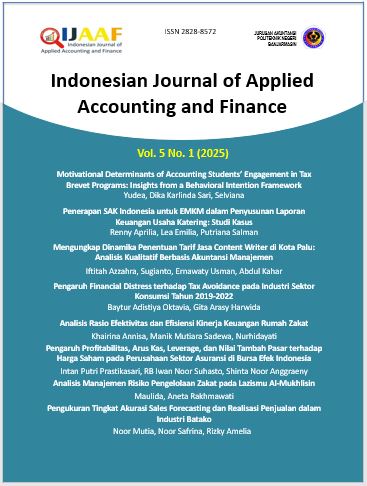
Analisis Rasio Efektivitas dan Efisiensi Kinerja Keuangan Rumah Zakat Tahun 2024
DOI:
https://doi.org/10.31961/ijaaf.v5i1.15021Kata Kunci:
Effectiveness, Efficiency, Financial Performance, Financial Ratios, Zakat Infak Sedekah (ZIS)Abstrak
Penelitian ini bertujuan untuk mengevaluasi tingkat efektivitas dan efisiensi dalam pengelolaan keuangan Rumah Zakat sepanjang tahun 2024. Metode yang digunakan adalah pendekatan kuantitatif deskriptif, dengan menganalisis 22 rasio keuangan yang disusun berdasarkan indikator evaluasi dari PUSKAS BAZNAS, yang bersumber dari laporan keuangan auditan tahun 2024. Temuan menunjukkan bahwa efektivitas dalam penyaluran dana tergolong sangat tinggi, dibuktikan oleh Net Allocation to Collection Ratio sebesar 91,31% dan Turn Over Ratio sebesar 10,06. Meskipun demikian, pencapaian tersebut tidak diiringi dengan efisiensi yang memadai dalam proses penghimpunan dana, yang ditunjukkan oleh Rasio Biaya Penghimpunan mencapai 108,95%, jauh melampaui batas efisiensi yang ditentukan. Ketimpangan antara efektivitas yang tinggi dan efisiensi yang rendah ini menunjukkan urgensi untuk melakukan pembaruan strategi penghimpunan, seperti pengutan penerapan digitalisasi sistem, peningkatan sinergi antar-lembaga zakat, serta penguatan komunitas sebagai basis pengelolaan. Temuan ini memberikan dorongan bagi perbaikan indikator evaluasi kinerja Organisasi Pengelola Zakat (OPZ), sekaligus mengarah pada penguatan tata kelola zakat yang berkelanjutan dan sejalan dengan prinsip-prinsip syariah.
Unduhan
Referensi
Abdullah, M., & Suhaib, A. Q. (2011). The impact of zakat on social life of Muslim society. Pakistan Journal of Islamic Research, 8(1), 85–91.
Alfina, R., & Putra, P. (2021). Analisis Kinerja Keuangan Lembaga Amil Zakat dengan Metode Data Envelopment Analysis (DEA)(Studi pada Lembaga Amil Zakat Dompet Dhuafa Republika). Paradigma, 18(1), 10–20.
Anisyah, S. S., Prihatni, R., & Nasution, H. (2024). Analisis Kinerja Keuangan Lembaga Amil Zakat Nasional Rumah Zakat Periode 2017-2022. Jurnal Akuntansi, Perpajakan dan Auditing, 5(3), 473–484.
Handayani, L., Putri, K. W., & Fahmi, M. Y. (2019). Factors Affecting Community Trust to Pay Zakat at the National Board of Zakat (BAZNAS) of South Kalimantan Province. Indonesian Conference of Zakat-Proceedings, 179–191.
Hassan, M. K., & Ashraf, A. (2010). An integrated poverty alleviation model combining zakat, awqaf and micro-finance. Seventh International Conference–The Tawhidic Epistemology: Zakat and Waqf Economy, Bangi, Malaysia, 261–281.
Jahja, T. I., Yusuf, N., & Badu, R. S. (2023). Analisis Efisiensi dan Efektivitas Pengelolaan Keuangan Badan Amil Zakat. Jambura Accounting Review, 4(2), 273–281.
Nahri, A., & Mutia, E. (2024). Pengaruh Teknologi dan Good Corporate Governance terhadap Efisiensi Pengelolaan Zakat di Provinsi Aceh. Jurnal Ilmiah Mahasiswa Ekonomi Akuntansi, 9(4), 237–250.
Nurhasanah, E. (2021). Efektivitas Penyaluran Dana Zakat Infak dan Sedekah pada Badan Amil Zakat Nasional (Periode Tahun 2016-2018). Jurnal Ekonomi Syariah, 6(1), 1–15.
Rifan, A. A., Wahyudi, R., & Nurani, O. P. (2020). Analisis Efektivitas Distribusi Zakat pada Baitulmal Bank Syariah Indonesia. Al-Tijary, 6(1), 31–40.
Yulianti, I., & Fadhillah, R. (2024). Analisis Efektivitas dan Efisiensi Kinerja pada Badan Amil Zakat Nasional Provinsi Kalimantan Selatan. Indonesian Journal of Applied Accounting and Finance, 4(2), 205–217.
Zaenal, M. H. (2020). Rasio Keuangan Organisasi Pengelola Zakat. Publications. BAZNAS Research and Development Directorate, 4.
Unduhan
Diterbitkan
Cara Mengutip
Terbitan
Bagian
Lisensi
Hak Cipta (c) 2025 Khairina Annisa, Manik Mutiara Sadewa, Nurhidayati

Artikel ini berlisensi Creative Commons Attribution 4.0 International License.