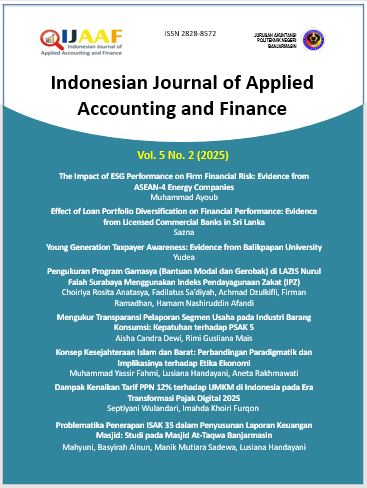
Rethinking Muslim Consumption: Israf and Tabdzir as Ethical Boundaries in Everyday Economic Behavior
DOI:
https://doi.org/10.31961/ijaaf.v5i2.15565Keywords:
Economic Behavior, Ethical Boundaries, Israf and Tabdzir, Muslim Consumption, WasatiyyahAbstract
In recent decades, consumption patterns in Muslim societies have increasingly reflected global consumer culture characterized by excess and waste. This trend contradicts Islamic ethical teachings that emphasize moderation and responsibility in economic behavior. This study aims to examine israf (excessiveness) and tabdzir (wastefulness) as ethical boundaries that regulate everyday Muslim consumption. Using a qualitative conceptual approach based on Qur’anic teachings and contemporary Islamic economics literature, this paper analyzes how these concepts function as moral constraints in economic decision-making. The findings show that israf represents consumption beyond reasonable limits, while tabdzir refers to wasteful and unproductive use of resources. Rather than being treated as neutral behavioral categories, both concepts serve as ethical limits that prevent deviation from moderation (wasatiyyah). This study contributes to Islamic economic discourse by providing a simplified framework of ethical bounded consumption that aligns with sustainability and responsible resource use.
Downloads
References
Ajzen, I. (1991). The theory of planned behavior. Organizational Behavior and Human Decision Processes, 50(2), 179–211. https://doi.org/10.1016/0749-5978(91)90020-T.
Arum, H., & Mawardi, M. (2025). Waste and Overconsumption in Modern Finance: An Analysis of Qs Values. Al-Isra: 26-27. Al-Muzdahir: Jurnal Ekonomi Syariah, 7(1), 30-50. https://doi.org/10.55352/ekis.v7i1.1375.
Biplob, H., & Abdullah, M. F. (2021). The Concept of Wasatiyyah in Consumption: An Analysis from Islamic Financial Jurisprudence. ICR Journal, 12(1), 11-26. https://doi.org/10.52282/icr.v12i1.810.
Budiman, M. A. (2014). The significance of waqf for economic development. Equilibrium: Jurnal Ekonomi Syariah 2(1), 19-34. https://journal.iainkudus.ac.id/index.php/equilibrium/article/view/718.
Budiman, M. A., Mairijani, & Nurhidayati. (2019). Persepsi dan Perilaku Konsumsi Masyarakat Muslim Terhadap Produk Halal. In Proceeding of National Conference on Asbis, 4, 184-194.
Budiman, M.A. (2021). Pendekatan Maqasid Syariah dan Peran Keuangan Syariah untuk Mitigasi Dampak Ekonomi Pandemi Covid-19. Indonesian Journal of Applied Accounting and Finance, 1(2), 221-230. https://ejurnal.poliban.ac.id/index.php/IJAAF/article/view/ 14702.
Chapra, M. U. (2008). The Islamic vision of development in the light of maqasid al-Shariah. Occasional Papers 235, The Islamic Research and Teaching Institute (IRTI). https://ideas.repec.org/p/ris/irtiop/0235.html.
Fahmi, M. Y., Mawardi, I., Herianingrum, S., & Budiman, M. A. (2023). The Relevance of Sustainable Development Goals (SDGS) with Maqashid Sharia. Migration Letters, 20(S12), 313-321. https://migrationletters.com/index.php/ml/article/view/5947.
Fitriani, H. (2023). Kontekstualisasi Israf dan Tabzir dalam Pengelolaan Harta Perspektif Tafsir Al-Munir Karya Wahbah Az-Zuhaili. Mashahif Journal Qur’an Hadits Stud., 2(2), 1–14. https://urj.uin-malang.ac.id/index.php/mashahif/article/view/3652.
Futerman, A., & Block, W. (2021). A Critique of the Neoclassical Approach to Consumer Choice. Dialogi Polityczne, 13(30), 201–228. https://doi.org/10.12775/DP.2021.011.
Hasan, M.M., Karim, F., & Ripon, M. B.. (2025). Behavioral Economics and Consumer Decision-Making: An Integrative Review. Business & Social Sciences, 3(1) 1-8. https://doi.org/10.25163/business.3110228.
Khan, F. (2021). Preferences and constraints on an Islamic consumer: An analysis from Islamic perspective. Journal of Humanities, Social and Management Sciences (JHSMS), 2(1), 85-94. https://doi.org/10.47264/idea.jhsms/2.1.8.
Koul, S., & Jasrotia, S. (2025). How much is too much? Journey from compulsive buying to addiction of fashion products. Social Responsibility Journal, 21(8), 1686–1703. https://doi.org/10.1108/srj-02-2025-0122.
Kurnia Putra, N., Amrin, A., Abu Zinah, M. M., Masuwd, M., & Subhan, S. (2023). Consumption from an Islamic Economic Perspective: Study of Quranic Verses on Consumption. Demak Universal Journal of Islam and Sharia, 1(01), 37–45. https://doi.org/10.61455/deujis.v1i01.21.
Lubis, D., Rodoni, A., & Amalia, E. (2022). Prevention of Tabzir in Muslim Households Food Consumption. Jurnal Ekonomi Islam, 13(1), 93–120. https://doi.org/10.21580/economica.2022.13.1.13355.
Mahdi, S. I. (2021). Consumption Function in Islamic Economics. American Journal of Islam and Society, 1(2), 133–136. https://doi.org/10.35632/ajis.v1i2.2803.
Makky, N. L. A. Q., & Yazid, M. (2025). The Concept of Israf and Tabdzir: A Guide To Wise Consumption in Islam. Maro: Jurnal Ekonomi Syariah dan Bisnis, 8(2), 270–279. https://doi.org/10.31949/maro.v8i2.13421.
Marín-Beltrán, I., Demaria, F., Ofelio, C., Serra, L., Turiel, A., Ripple, W., Mukul, S., & Costa, M. (2021). Scientists' warning against the society of waste.. The Science of the total environment, 151359, 1-14. https://doi.org/10.1016/j.scitotenv.2021.151359.
Osiievska, V., Maksiutenko, I., Pysarenko, N., Berezivska, O., & Mykhailenko, T. (2025). The Impact of Social Media on Consumer Behavior: Current Status, Emerging Trends, and Future Prospects. International Journal of Organizational Leadership 14, 303-313. https://ijol.cikd.ca/article_60821_6310b8e1105052443d839ce59fd9fc07.pdf.
Pellegrino, A., & Shannon, R. (2021). Materialism's Influence on Unsustainable Consumption Across Social Networking Sites: A Systematic Review. International Journal of Business and Economics Research, 10(4), 125-140. https://doi.org/10.11648/j.ijber.20211004.13.
Peattie, K. (2010). Green consumption: Behavior and norms. Journal of Marketing Management, 26(5–6), 195–206. https://doi.org/10.1080/0267257X.2010.489575.
Pusparini, M., Herianingrum, S., Bahari, Z., & Furqani, H. (2024). Scrutinizing a frugal lifestyle in spiritual dimensions: an Islamic ethical consumption framework. International Journal of Ethics and Systems. https://doi.org/10.1108/ijoes-01-2024-0027.
Rizqa, Fahmi, M.Y., & Budiman, M.A. (2021). Pengaruh Pendistribusian Zakat Produktif terhadap Tingkat Pengurangan Kemiskinan Mustahik di Kota Banjarmasin. Indonesian Journal of Applied Accounting and Finance, 1(1), 33-46. https://doi.org/10.31961/ijaaf.v1i1.1165.
Yusof, S. A., Budiman, M. A., Amin, R. M., & Abideen, A. (2019). Holistic development and wellbeing based on Maqasid Al-Shari'ah: The case of South Kalimantan, Indonesia. Journal of Economic Cooperation & Development, 40(4), 1-21. https://doi.org/10.5281/zenodo.17119474.
Downloads
Published
How to Cite
Issue
Section
License
Copyright (c) 2025 Mochammad Arif Budiman

This work is licensed under a Creative Commons Attribution 4.0 International License.