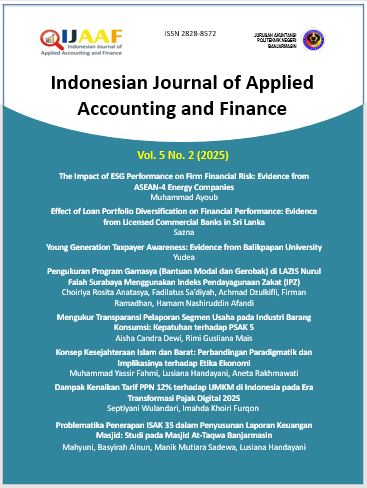
Young Generation Taxpayer Awareness: Evidence from Balikpapan University
DOI:
https://doi.org/10.31961/ijaaf.v5i2.15330Keywords:
Institutional Trust, Tax Awareness, Tax Compliance, Tax Education, University StudentsAbstract
Taxation is a crucial pillar of state finance and a civic responsibility that requires strong awareness among future taxpayers. This study aims to explore the awareness of students at Balikpapan University as potential taxpayers and to analyze the factors influencing their attitudes toward tax compliance. Using a qualitative descriptive approach through Focus Group Discussions with twelve students from both accounting and non-accounting backgrounds, the study applies thematic analysis to identify patterns of knowledge, perceptions, and attitudes toward taxation. The findings indicate that although students understand the importance of taxes for national development, their knowledge of tax regulations remains limited, particularly among non-accounting students. Sanctions are viewed as necessary but inconsistently enforced, while distrust in institutions due to corruption and weak accountability emerges as a key barrier to tax compliance. Although educational programs such as Tax Goes to Campus increase short-term awareness, they lack depth and sustainability. Students express willingness to comply voluntarily if tax systems are transparent and fair, highlighting the importance of integrating tax education into higher education and strengthening institutional credibility. These findings suggest that early and systematic tax education, supported by transparent governance, is essential to foster voluntary tax compliance among the younger generation.
Downloads
References
Agustiningsih, F., and I. Isroah. 2016. “The Influence of Taxpayer Awareness, Tax Sanctions, and Taxpayer Morality on Taxpayer Compliance.” Jurnal Nominal 5 (2): 96–110. https://doi.org/10.21831/nominal.v5i2.11729
Ayu, I. G. A., and N. Sari. 2017. “The Effect of Taxpayer Morality and Tax Sanctions on Taxpayer Compliance.” Jurnal Ilmu dan Riset Akuntansi 6 (3): 1–15. Sekolah Tinggi Ilmu Ekonomi Indonesia ( STIESIA ) Surabaya.
Beti, S., A. Nasution, and Y. Yulianto. 2016. “The Influence of Taxpayer Awareness, Knowledge, and Sanctions on Individual Taxpayer Compliance.” Jurnal Online Mahasiswa Fakultas Ekonomi 3 (1): 201–10. https://ejournal.unikama.ac.id/index.php/jrma/article/download/1196/935
Braun, V., and V. Clarke. (2006). “Using Thematic Analysis in Psychology.” Qualitative Research in Psychology 3 (2): 77–101. https://doi.org/10.1191/1478088706qp063oa.
Creswell, J. W. (2014). Research Design: Qualitative, Quantitative, and Mixed Methods Approaches. 4th ed. Thousand Oaks, CA: Sage.
Fachirainy, H., L. Mardiasmo, & T. Dewi. (2021). “Taxpayer Trust and Compliance: Evidence from Young Generations in Indonesia.” Journal of Accounting and Taxation 13 (4): 211–21. https://doi.org/10.5897/JAT2021.0478.
Guest, G., E. Namey, & K. McKenna. (2017). “How Many Focus Groups Are Enough? Building an Evidence Base for Nonprobability Sample Sizes.” Field Methods 29 (1): 3–22. https://doi.org/10.1177/1525822X16639015.
Harsono, B., A. Pradana, & N. Putra. (2022). “Millennials and Generation Z: Building Tax Morale for Future Compliance.” International Journal of Public Administration 45 (6): 495–507. https://doi.org/10.1080/01900692.2021.1929571.
Jaya, M. (2019). “The Effect of Taxpayer Awareness and Knowledge on Compliance.” International Journal of Accounting, Finance and Business 4 (20): 55–65.
Krueger, R. A., and M. A. Casey. (2015). Focus Groups: A Practical Guide for Applied Research. 5th ed. Thousand Oaks, CA: Sage.
Lincoln, Y. S., & Guba, E. G. (1985). Naturalistic Inquiry. Beverly Hills, CA: Sage.
Mardiasmo. (2016). Perpajakan Edisi Revisi. Yogyakarta: Andi.
Resmi, S. (2017). Perpajakan: Teori dan Kasus. Jakarta: Salemba Empat.
Resnik, D. B. (2015). Ethics of Research with Human Subjects: Protecting People, Advancing Science, Promoting Trust. Cham: Springer. https://doi.org/10.1007/978-3-319-19654-4.
Suardana, K., & G. Gayatri. (2020). “Tax Knowledge and Compliance: A Study among Indonesian Millennials.” Journal of International Business and Taxation 5 (1): 23–35. https://doi.org/10.24843/eja.2020.v30.i09.p11.
Waluyo. (2017). Perpajakan Indonesia. Jakarta: Salemba Empat.
Downloads
Published
How to Cite
Issue
Section
License
Copyright (c) 2025 Yudea

This work is licensed under a Creative Commons Attribution 4.0 International License.